

Meta recently published an engineering paper titled Exploring Hierarchical Interest Representation for Meta Ads Deep Funnel Optimization. The paper is written for AI engineers, but the practical takeaway for advertisers is straightforward:
Meta is getting better at deciding who should see your ads by understanding what your business sells, what your creative communicates and how those ideas connect to customer behavior.
What’s Meta’s New Ads Algorithm Going to To?
Meta’s new research is designed to help the system learn from a wider network of relationships among people, advertisers, ads, products, websites and conversion events. Instead of simply knowing that someone clicked an ad for hiking shoes, Meta may better understand how those shoes relate to trail running, outdoor travel, endurance sports and technical apparel. Their new build is meant to help supply additional information about users, which might influence conversion behavior.
What the heck does this mean?
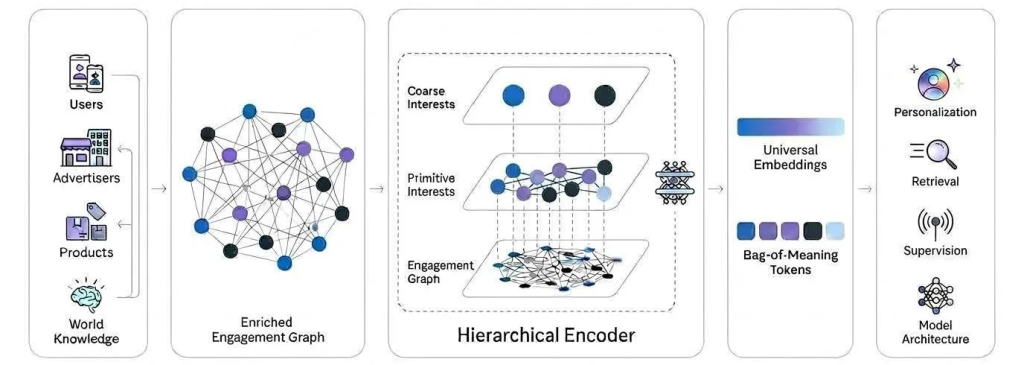
“Hierarchical Interest Representation is an upstream representation layer designed to improve upon Meta’s deep funnel ranking optimization. It aims to connect businesses with the population of people on our platforms who carry the most genuine, latent interest in what they offer. The system is intended to function across Meta’s broader recommendation ecosystem, such as Meta’s Generative Ads Model (GEM), Andromeda, and the Adaptive Ranking Model, to advance deep funnel optimization.“
The 30-second takeaway
Meta is getting much better at understanding what your business sells and who is likely to become a customer, even when there aren’t many purchase events.
Instead of relying primarily on:
- Pixels
- Purchase history
- Interest targeting
- Lookalike audiences
Meta is increasingly building an AI model that understands:
People + Products + Creative + Businesses + Behavior
…all inside one giant knowledge graph.
What Should Advertisers Do About It?
Do not rebuild your account overnight or abandon interest targeting completely. Instead, shift where you invest your time. Spend less time creating increasingly complicated audience structures and more time improving the information Meta uses to understand your campaign.
That means:
- Simplifying campaign structures
- Testing broader audiences
- Producing genuinely different creative concepts
- Writing more specific copy
- Improving offers
- Strengthening landing pages
- Cleaning up product feeds
- Sending Meta better conversion signals
- Measuring customer quality, not just cheap leads
The competitive advantage is moving away from audience hacks and toward strategy, creative, positioning and data quality.
Where Advertisers Should Spend Their Time
| Spend Less Time On | Spend More Time On |
|---|---|
| Overlapping interest audiences | Broad or lightly constrained targeting |
| Audience hacks/layers | Building message/creative for more buyer types |
| Generic copy | Specific customer and product language |
| Minor ad variations | Different creative concepts |
What Problem Is Meta Trying to Solve?
Meta learns from user behavior. Someone watches a video, clicks an ad, visits a landing page, submits a form or makes a purchase. Each action helps Meta understand who may respond to similar advertising. The challenge is that the most valuable actions happen least often. A campaign might generate:
- 500,000 impressions
- 3,000 website visits
- 80 additions to cart
- 25 purchases
Meta has thousands of engagement signals, but only 25 confirmed purchases. The same issue exists in lead generation. A campaign may produce 100 form submissions, but only 10 become qualified opportunities and one becomes a customer. If the advertiser never sends that deeper information back to Meta, the platform learns which people submit forms—not which people become valuable customers.
If Meta wants to provide the best results, it needs to build infrastructure that “understands” the broader context of each of its users.
Meta Is Moving Beyond Traditional Targeting
For years, advertisers built campaigns around interests, behaviors, lookalikes and manually segmented audiences. That approach depended on the media buyer’s ability to describe the ideal customer in advance. But, today, Meta’s systems are increasingly capable of evaluating broader questions:
- What is this product?
- Who might need it?
- What problem does it solve?
- How does it relate to other interests or behaviors?
- Which patterns may suggest purchase intent?
Example:
Someone shopping for accounting software may never interact with an interest called “small-business accounting.” They may instead research payroll, hiring, tax planning, business banking and customer-management tools. Meta’s newer systems are designed to understand how those behaviors relate to one another. As humans, we aren’t manually able to understand the complex web of those relationships. But, big data, and Meta’s AI, supposedly can. So, a more complicated audience is not automatically a better audience.
Your Creative Is Becoming Part of Your Targeting
We know… We keep hearing that “creative is the new targeting.” But think about how these new Meta audience graphs work.
Let’s say I’m selling a particular pair shoes. There might be 50 different reasons why my customer base would find those shoes interesting, and might want to buy them:
The Old Meta
Meta looked at signals like:
- This person clicked Nike ads
- They bought running shoes
- They liked marathon pages
So it concluded – “This person likes running.”
The New Meta
Now Meta tries to understand things much more like ChatGPT would. Instead of simply seeing:
“Running shoes”
it understands:
- trail runner
- beginner runner
- marathon training
- pronation support
- recovery
- orthotics
- outdoor adventure
- race preparation
- hydration
- fitness journey
Then it compares those concepts against everything someone has interacted with across Facebook and Instagram.
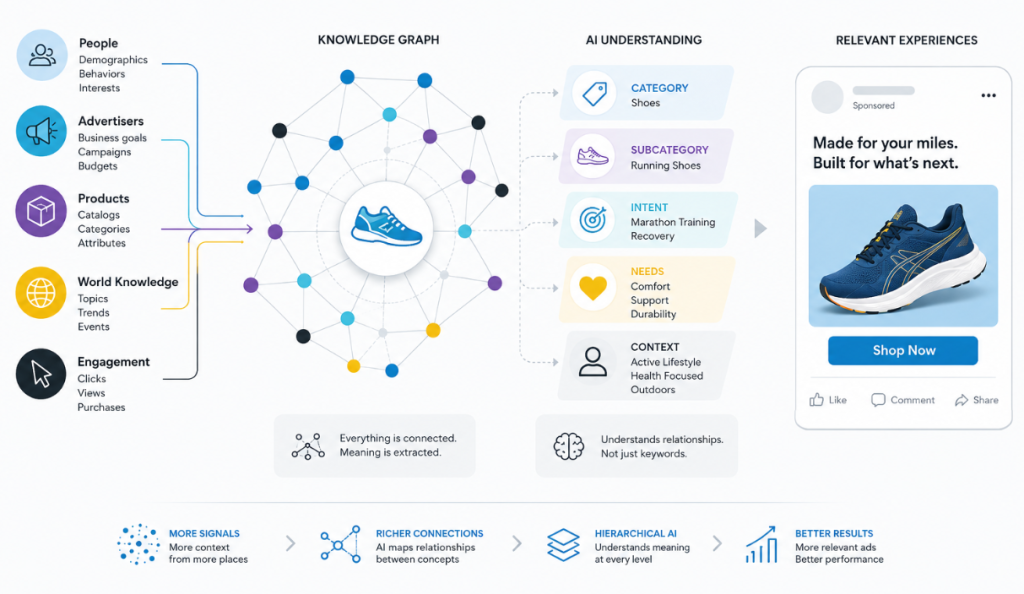
According to Meta’s engineers, the new structure of the algorithm is smart enough to know each individual’s preferences enough to serve them the correct message in order to drive a purchase. That means that, as an advertiser or marketer, we need to have enough relevant messages around that product so that Meta can supply the appropriate creative to the appropriate person.
Meta is learning from more than audience behavior. Its systems can use information from:
- Ad copy
- Headlines
- Images
- Video
- Product descriptions
- Catalog attributes
- Business information
- Conversion activity
That means creative is no longer only the message shown after the audience has been selected. Creative can also help Meta understand who may find the ad relevant. We need to give more detail, and understand our customers MORE, not LESS.
Messaging Matters More Than Ever
Let’s compare some different ad copy to illustrate the differences.
Generic: Work smarter with a better business platform.
Specific: Schedule technicians, send estimates and collect payments from one dashboard built for residential HVAC companies.
The second ad identifies the customer, industry, product category, use case and benefit. It gives both Meta and the customer more useful context.
Tobie Tip: Every ad should make it clear who the offer is for, what is being sold, what problem it solves and what action the customer should take.
Generic advertising creates ambiguity.
Consider a home-services ad.
Weak: Quality service you can trust.
Stronger: Same-day air-conditioning repair for Phoenix homeowners. Book a licensed technician today.
Or a university ad.
Weak: Take the next step toward your future.
Stronger: Earn your online master’s degree in organizational leadership without stepping away from your career.
Specificity helps customers understand the offer. It also gives Meta clearer information about the customer, product and use case. This does not mean stuffing advertisements with keywords. It means replacing vague claims with useful features that are interesting to your different customer types.
Creative Diversity Means Different Ideas
Many advertisers confuse creative diversity with producing more versions of the same ad. Changing a background color or moving the logo does not create a meaningfully different concept.
A stronger testing plan explores different:
- Customer problems
- Benefits
- Use cases
- Objections
- Offers
- Testimonials
- Demonstrations
- Stages of awareness
For a home-services company, one ad might focus on emergency repair, another on preventive maintenance and another on financing. Those concepts give Meta different signals and give customers different reasons to respond.
Tobie Tip: Test differences in ideas before differences in design. A new problem, benefit or offer usually teaches you more than a new font or crop.
The Bigger Strategic Shift
Meta’s AI is not infallible. It may not understand which customers have poor retention, which products have the best margins or which leads are unlikely to become customers. Advertisers still need judgment, measurement and strategy. Meta is increasingly deciding who should see an ad based on how well it understands what the advertiser is selling.
The strongest advertisers will spend less time trying to outsmart the targeting interface and more time improving:
- Positioning
- Offers
- Creative
- Messaging
- Landing pages
- Product information
- Conversion data
The next generation of Meta Ads performance will not come from finding one more hidden audience. It will come from making your business easier for Meta—and your customers—to understand.