

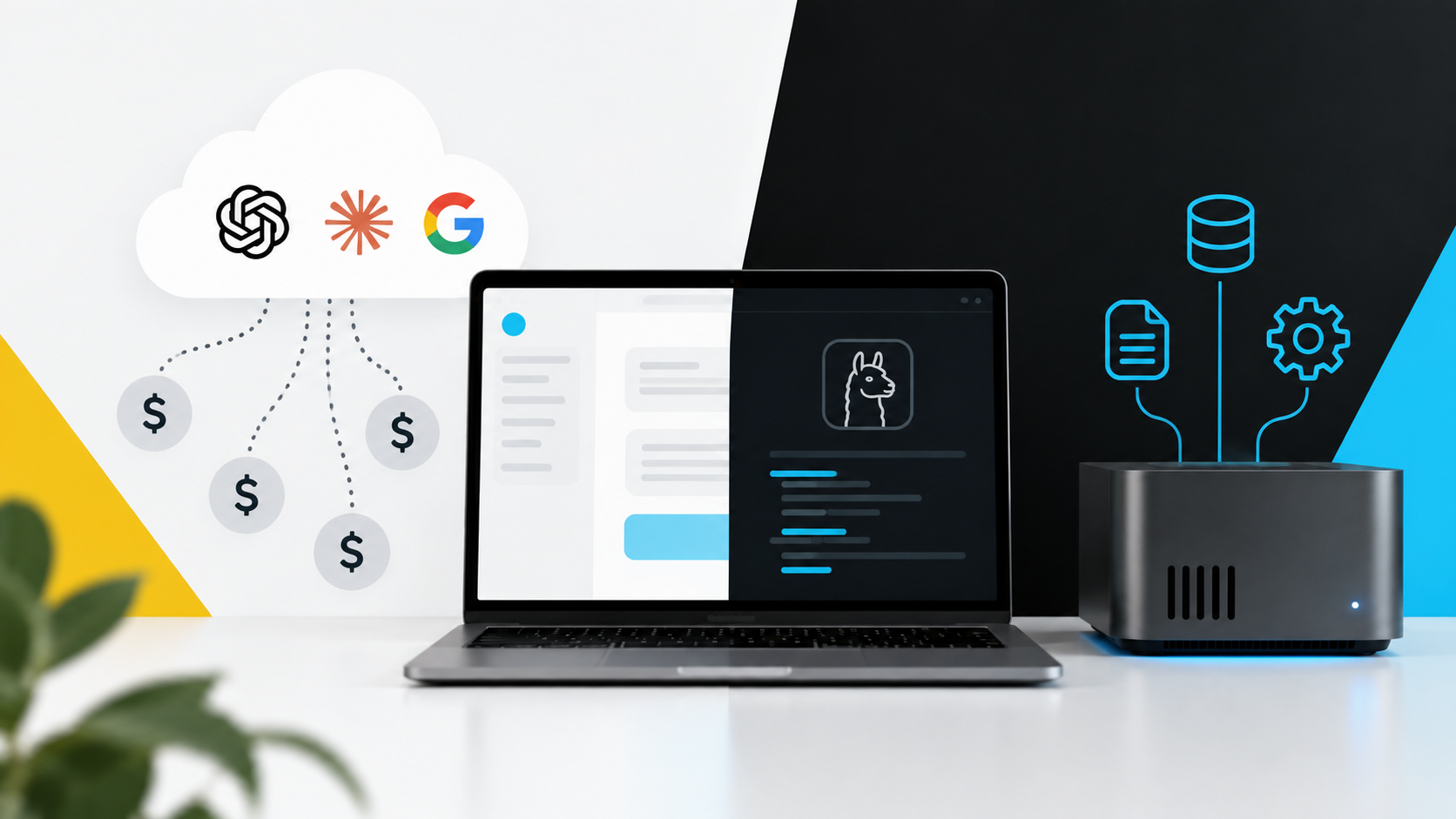
Most businesses access artificial intelligence through apps such as ChatGPT, Claude or Gemini. These platforms make AI remarkably easy to use: open the app, enter a prompt and let someone else supply the model, tools and computing power.
But that isn’t the only way to use AI.
A growing number of businesses are exploring local AI models that run on computers or servers they control. Privacy is one reason. Control is another. But the most significant long-term benefit may be cost.
For repeatable, high-volume tasks, a free or inexpensive local model can eliminate much of the per-token expense associated with cloud-based AI.
The model isn’t the app
The easiest way to understand the difference is to think of the model as the engine and the app as the vehicle built around it.
ChatGPT combines OpenAI models with an interface, file uploads, web research, memory, image creation and other tools. Claude and Gemini follow the same general approach.
A local AI setup separates those pieces. A business can download a model and use software such as LM Studio to run it on its own computer.
Many downloadable models are described as open models or, more precisely, open-weight models. Open describes how the model is distributed. Local describes where it runs.
An open-weight model can run on a laptop, on a private company server or through a cloud hosting provider.
| Local AI Model | Hosted AI App | |
|---|---|---|
| Examples | Gemma, Qwen, Mistral, gpt-oss running through LM Studio or Ollama | ChatGPT, Claude, Gemini |
| Where it runs | Your computer or company-controlled server | Provider’s cloud infrastructure |
| Cost structure | Hardware + operating costs; typically no per-token inference fee when running on your own hardware | Subscription, usage limits and/or token-based API fees |
| Setup | Requires installation, model selection and configuration | Usually ready to use immediately |
| Ease of use | More technical | Very easy |
| Data control | Data can remain on infrastructure you control | Data is processed through the provider’s service |
| Model choice | You choose and can change the model | Models are determined by the platform |
| Performance | Depends heavily on the model and your hardware | Access to powerful cloud infrastructure and leading models |
| Web access & tools | Usually requires additional setup | Often built in |
| Maintenance | You manage models, hardware, updates and security | Provider handles most infrastructure |
| Best for | High-volume, repeatable, narrowly defined tasks | Research, complex reasoning, creative work and general-purpose AI |
| Economics at scale | Can become very attractive as usage increases | Costs generally increase with usage |
| Good example | Categorizing 500,000 customer comments | Researching a new market and developing a strategy |
Why local AI can cost less
Most commercial AI services charge through subscriptions, usage limits or API fees based on the number of tokens processed.
Local models still process tokens. The difference is that the business is using its own computing resources instead of paying an outside provider for every token.
Many open-weight models are free to download, subject to their individual licenses. Tools such as LM Studio allow downloaded models to run without consuming cloud inference credits, while also helping users choose versions that fit their available hardware.
That doesn’t mean local AI is free to operate. Businesses still need to consider:
- Computer hardware
- Storage
- Electricity
- Setup and maintenance
- Security
- Technical support
- Model testing and monitoring
For occasional use, paying for ChatGPT or an AI API will usually be easier and less expensive than managing a local system.
The economics can change when a business needs to perform the same task hundreds of thousands—or millions—of times. At that point, replacing variable per-token charges with more predictable internal computing costs can become compelling.
Smaller models can be enough
Businesses often assume they need the most powerful model available. That may be true for complex strategy, advanced reasoning or difficult research. It’s rarely true for every task.
A smaller model may be perfectly capable of:
- Categorizing customer comments
- Extracting fields from documents
- Summarizing transcripts
- Tagging content
- Standardizing product information
- Cleaning text
- Routing requests
- Creating routine first drafts
- Searching an internal document collection
Some open models are also designed or tuned for particular types of work. Instead of using an expensive general-purpose model for everything, a business can match a smaller model to a narrow task.
Google’s Gemma family, for example, includes open-weight models in multiple sizes and supports use cases such as summarization, question answering and reasoning. OpenAI’s gpt-oss family provides downloadable reasoning models designed to run on user-controlled infrastructure.
The local model doesn’t need to produce the best answer any AI could possibly create. It needs to produce an acceptable answer consistently, quickly and economically.
The race to local AI is lowering the barrier
Local models once required specialized hardware and substantial technical knowledge. That barrier is falling.
Model developers are producing smaller and more efficient models. Quantization can compress models so they need less memory. Applications such as LM Studio provide a visual interface for discovering, downloading and using models without requiring someone to build the entire environment from scratch. LM Studio currently supports local models including Qwen, Mistral, Gemma and gpt-oss across compatible Mac, Windows and Linux systems.
Ollama provides another path. It allows users to download and run local models while also offering APIs and integrations for connecting those models to applications and automated workflows.
Running a useful local model still requires some technical ability. But the expertise needed is moving from “AI research lab” toward “competent internal IT or marketing-technology team.”
That should get the attention of businesses performing high volumes of AI-assisted work.
How to test a local model
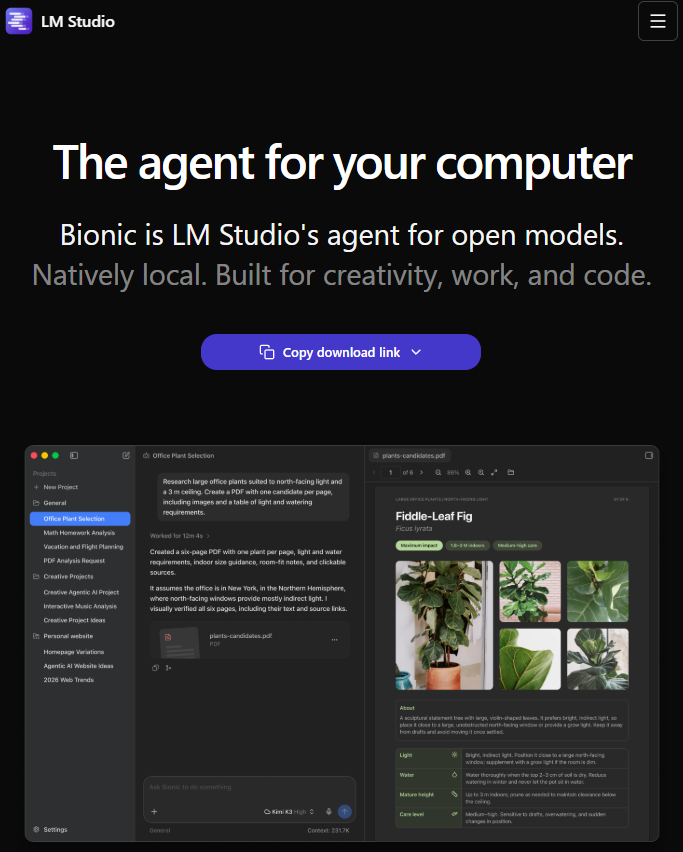
LM Studio is the most approachable place to begin if you don’t want to work from a command line.
The basic process is:
- Download and install LM Studio.
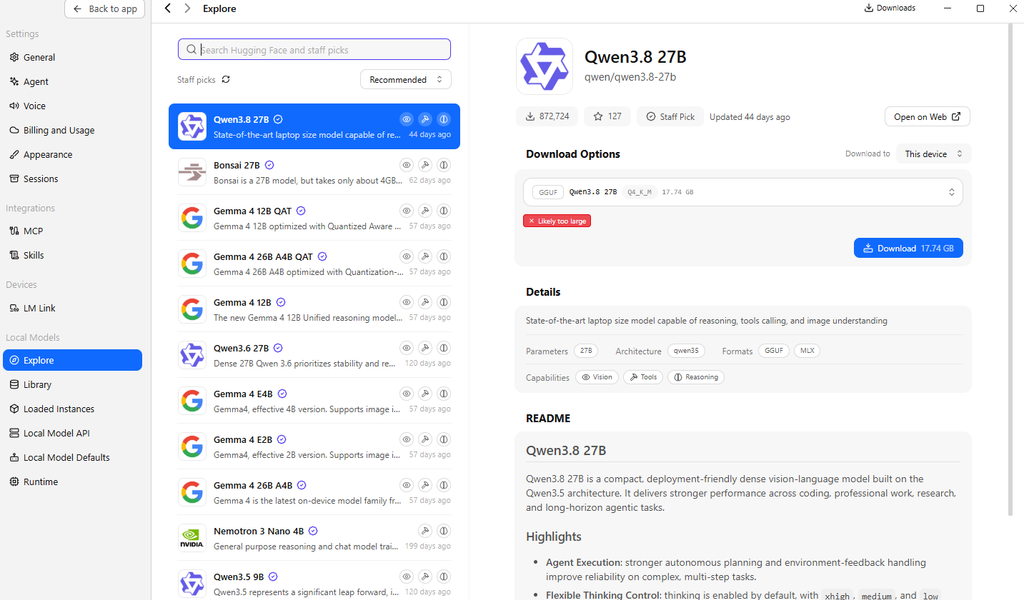
- Search its model library.
- Select an instruction-tuned model that fits your computer.
- Download and load the model.
- Test it against a real business task.
Start with a small model and a low-risk, repeatable process. Use the same instructions and sample inputs with both the local model and the hosted model you’re currently using.
Compare:
- Output quality
- Processing speed
- Consistency
- Setup time
- Human review required
- Hardware utilization
- Cost per completed task
Don’t compare models based only on a few impressive responses. A business case depends on whether the model can produce acceptable results repeatedly.
When local AI makes sense
Local AI deserves serious consideration when a task is:
- Repeated frequently
- Performed at significant volume
- Easy to evaluate
- Based on consistent inputs
- Expensive to run through an API
- Suitable for a smaller or specialized model
- Connected to information that should remain under company control
A hosted AI app will usually remain the better choice when the work requires current web research, the strongest available reasoning, extensive integrations or minimal technical maintenance.
Many businesses will ultimately use both. Hosted models can handle complex and changing work, while local models perform narrower tasks at scale.
The real opportunity is choosing the right model for the work
The most expensive approach may be sending every task to the largest available AI model simply because it’s convenient.
As open-weight models become more capable and easier to operate, businesses with some technical expertise should begin evaluating where local AI belongs in their technology stack.
The opportunity isn’t merely to replace ChatGPT. It’s to identify repeatable work, choose an appropriately sized model and build a system that produces reliable results at a sustainable cost.
Tobie Group helps businesses prioritize AI and automation opportunities, evaluate the technology involved and turn high-value use cases into practical workflows. If your organization is trying to determine where AI can save time or reduce operating costs, that’s the place to start.