

The Google ads algorithm update was fairly understated. The new setup, which launched on August 17, 2026 deserves more attention from anyone managing meaningful Google Ads spend.
We’ve started seeing the notification inside client accounts. Google has documented the change, reps have been talking about it, and the new Bid Target Adjustment Tool is live… But for something that could materially affect campaign economics, the rollout has been surprisingly quiet.
On the surface, this is a technical change affecting budget-constrained campaigns using Target CPA or Target ROAS.
The bigger lesson is about how advertisers should think about targets in an increasingly automated Google Ads ecosystem.
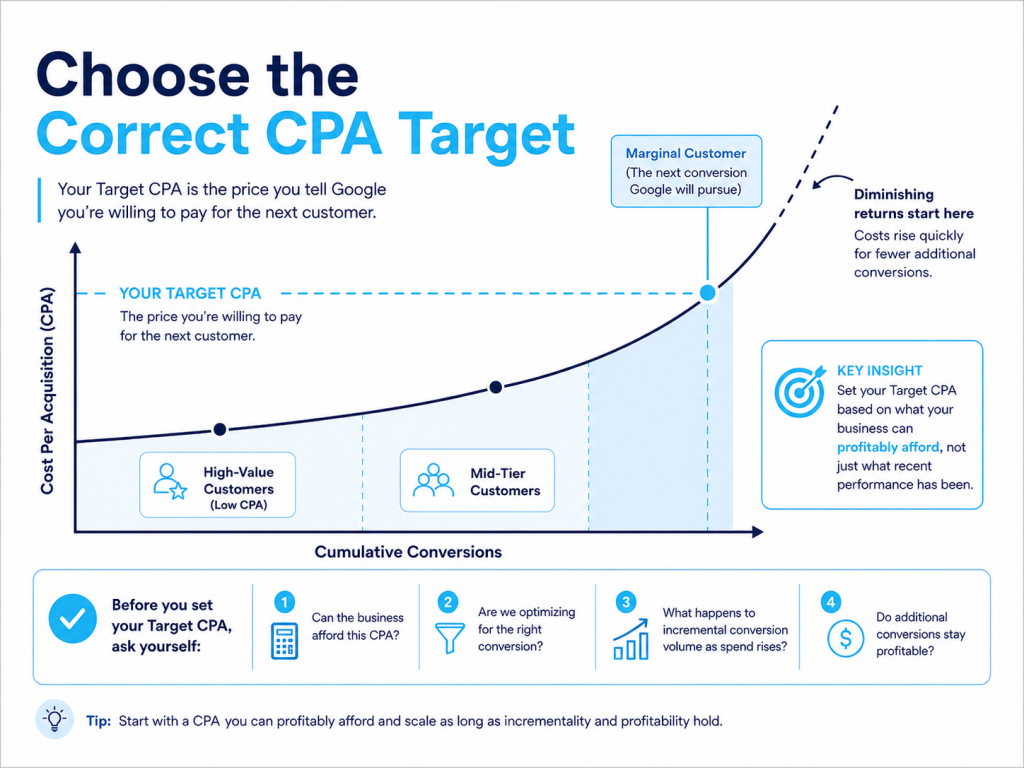
Your Target CPA is increasingly becoming the price you’re telling Google you’re willing to pay. And if you put $100 into that box, you should be prepared for Google to believe you.
Yeah, but hasn’t that always been the case? Well, kind of. It’s generally assumed that some campaigns perform better, some perform worse. Sometimes, ad managers use a lower CPA to even out costs across an entire account. Sometimes CPA targets can be used to control budget.
Google says that those fuzzy CPA targets are a thing of the past.
Google is giving advertisers more control over the business rules its algorithms optimize around. That makes it more important to understand what a conversion is truly worth, track the outcomes that matter, and set targets based on real economics rather than platform performance alone.
What Google Says Is Changing
Google says that beginning August 17, 2026, campaigns that are “Limited by budget” and use target-based bidding will optimize more consistently toward the target set by the advertiser.
Google’s own example is pretty direct:
If a campaign has a $10 Target CPA but has recently been producing conversions at $5, Google says the campaign may begin delivering closer to that $10 target. Advertisers who want to maintain performance closer to $5 can lower their target accordingly.
Google describes the change as a way to create more “predictable” performance, particularly as advertisers adjust budgets.
Google also says campaigns that are not budget-constrained will not change behavior. According to Google, unconstrained campaigns already scale in line with their stated targets.
That last point might be the most important one.
Your Cost or ROI Target Is an Important Economic Input
Google’s explanation is technically correct. It also risks focusing advertisers on the wrong question. Google says this update doesn’t directly increase your spending. Your daily and monthly budget limits still apply.

Fair enough.
But the more interesting question is:
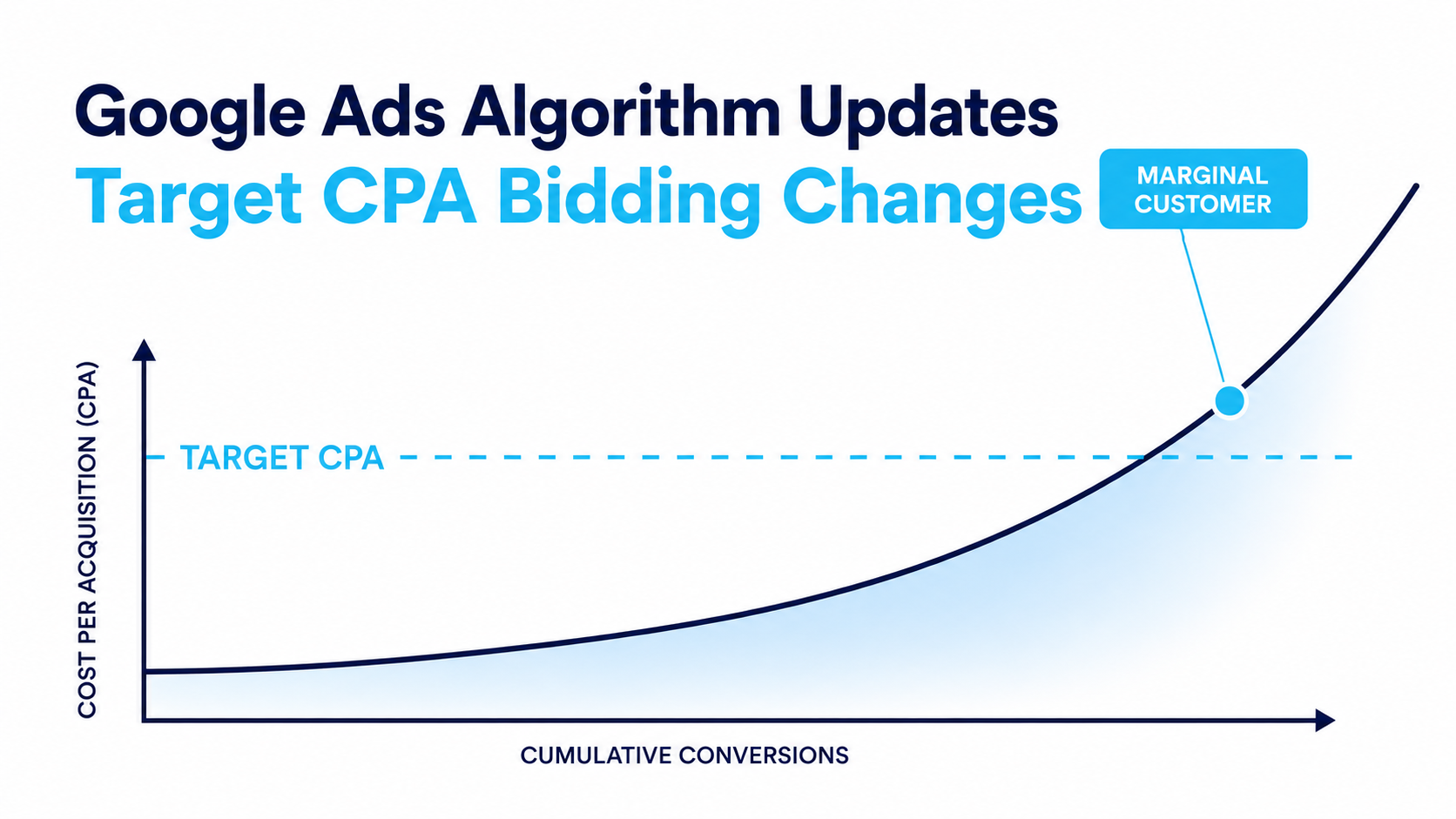
How much are you giving Google permission to spend to acquire the marginal (additional) conversion?
Imagine your Target CPA is $100, but the campaign has been averaging a $60 CPA.
There are two very different ways performance can move toward $100:
Scenario 1: Profitable scaling
Google finds considerably more conversions at $70, $80 and $90.
Your blended CPA increases, but so does customer volume.
Boom. Thanks Google! More customers because you’ve helped us scale!
We shouldn’t protect a beautiful $60 CPA simply because it makes the report look good. If the business can profitably acquire customers for $90, spending more to generate substantially more customers and revenue may be exactly what we want.
Scenario 2: Diminishing returns
Now imagine Google spends significantly more but finds only a few additional conversions.
Your CPA climbs from $60 toward $95, but conversion volume barely moves.
Google can correctly say it stayed within your $100 Target CPA.
The business owner can correctly ask why they’re spending substantially more money for roughly the same outcome.

The issue isn’t that CPA increased. The issue is what we received for the incremental dollars. That’s the piece marketers need to watch. See why this is an issue?
Better Algorithms Make Inputs More Important
We talk about inputs versus outcomes constantly at Tobie Group.
Leads, sales, revenue, CPA and ROAS are outcomes.
The ad manager’s job increasingly sits upstream…where the costing, ROI targets, etc. need to be set. Google’s smart bidding uses our conversion goals and targets to decide which opportunities (customers) to pursue.
So, as Google gets better at optimizing toward our inputs, the quality of those inputs becomes more important.
- Are we tracking the right conversions?
- Are we feeding Google form submissions, or can we distinguish qualified leads from junk?
- Do our conversion values actually reflect revenue and business value?
- Does the company know what it can profitably afford to pay for a lead or customer?
- Most importantly, does the Target CPA or Target ROAS entered into Google reflect the economics of the business?
Experienced Google Ads managers have historically used Target CPA and Target ROAS as levers. Set the target higher to loosen the system. Lower it to constrain things.That approach deserves another look.
Don’t enter a Target CPA into Google Ads that you aren’t actually comfortable with Google achieving.
So, What Should We Do About the New Google Ads Algorithm?
We wouldn’t respond to this update by immediately lowering every Target CPA to match recent performance. That could create the opposite problem.
Instead, look closely at campaigns where actual CPA has substantially outperformed Target CPA, especially campaigns that are budget constrained.
Then ask four questions:
- What can the business actually afford to pay for this conversion?
- Are we optimizing toward the right conversion and measuring quality?
- If spend increases, how much incremental conversion volume do we receive?
- Do those additional conversions remain profitable as Google moves further out on the cost curve?
Google recommends evaluating performance over one to two conversion cycles after making changes rather than reacting immediately to short-term fluctuations.
Google increasingly expects advertisers to tell its algorithms what business outcome they actually want. That means knowing what a conversion is worth, measuring the right outcomes and setting bidding targets that reflect reality.
If you tell Google you’re willing to pay $100 for a conversion, you should increasingly expect Google to take you at your word.
If sorting through Target CPA math for every campaign isn’t how you want to spend your week, that’s the exact judgment call a paid search advertising company earns its fee on.